Still blaming age for arthritis? What matters is managing inflammation!
This magazine provides health information about ingredients, not about the efficacy or effects of any specific product.
Arthritis is a very common condition among middle-aged and older adults, with more than about 4 million patients visiting hospitals for it every year. According to the Health Insurance Review and Assessment Service (HIRA), about 4,178,974 people visited hospitals for degenerative arthritis in 2022. In particular, many people saw their condition worsen as their activity levels dropped after the COVID-19 pandemic. Because arthritis is so common, it is also easy to neglect. Let's look at how to manage it.

1. Is arthritis a kind of "inflammation"? If you can't prevent it, manage it!
As the name suggests, arthritis means "inflammation" in the joints. Arthritis is divided into several types by cause, such as rheumatoid arthritis, but the arthritis common among middle-aged and older adults is often degenerative arthritis. Degenerative arthritis is a condition in which the bones, ligaments, and other parts of a joint wear down and become damaged with age, causing inflammation. Because it is common, people may take it lightly, but when it worsens it brings severe pain and a lower quality of life. It is pain that is hard to imagine without experiencing it, and there are even reports of pain more severe than labor pain during childbirth.
To prevent the damage that causes arthritis, you would have to stop using your joints, but staying still while going about daily life is practically impossible. The same is true of rheumatoid arthritis, where damage of unclear cause usually leads to inflammation. If we cannot prevent damage from aging or disease, one thing we can try is managing inflammation. There are several ways to do this, including receiving medical treatment and taking ingredients that may help ease inflammation for supplementary support.
A typical medical treatment is the steroid injection, often called a "joint shot" or "bone shot." Steroids give quick anti-inflammatory and pain-relieving effects, and they are among the most commonly used treatments. However, they are not a fundamental cure, so as arthritis progresses their effect gradually weakens and they may cause side effects. For this reason, they are recommended only for temporary pain relief when subjective symptoms are very severe.
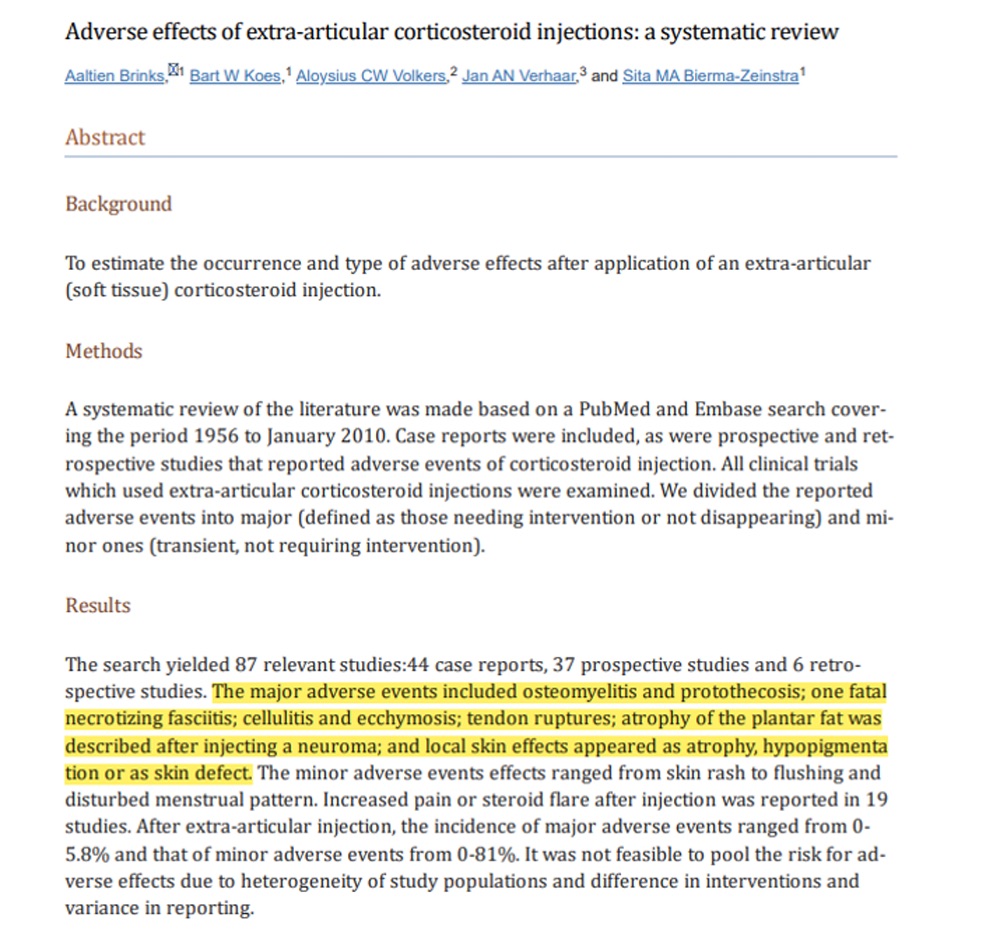
"Major adverse effects (of corticosteroid injections) reported include osteomyelitis, protothecosis, necrotizing fasciitis, cellulitis, ecchymosis, and tendon rupture, and local atrophy and pigmentation appeared in the skin."
Reference: Aaltien Brinks, Bart W Koes, Aloysius CW Volkers, Jan AN Verhaar, and Sita MA Bierma-Zeinstra. Adverse effects of extra-articular corticosteroid injections: a systematic review. BMC Musculoskelet Disord.
2. Good medicine tastes bitter: Andrographis paniculata and its anti-inflammatory effects draw new attention
If arthritis pain is not yet severe and you only need supplementary support, taking a health functional food known to help ease inflammation is one option.
Recently, ParActin, a substance extracted from Andrographis paniculata, has also drawn attention as a functional ingredient that helps relieve arthritis symptoms. Research on Andrographis paniculata is already active in academia, and its research value is already recognized, with 364 SCIE-level papers and 46,900 academic materials. With as many as 3.8 million Google searches, many people are also paying attention to Andrographis paniculata ParActin as a new joint health ingredient.
Andrographis paniculata is a medicinal herb handed down since ancient times in India and China for its anti-inflammatory and antioxidant effects. Its East Asian name, meaning "pierces the heart," comes from the saying that its bitter taste reaches all the way to the chest when held in the mouth. Since anti-inflammatory research on it began in 2004, it has been reported to be effective in various areas, including immune, antifungal, and antiviral activity. ParActin contains the functional component of Andrographis paniculata at a high purity of 50% and is an ingredient recognized by the MFDS as one that "may help joint health."
In fact, when an overseas research team gave ParActin to 60 patients with chronic rheumatism for 14 weeks, ParActin was effective in relieving symptoms in patients with rheumatoid arthritis and arthritis-related indicators also improved. In another study, no side effects were found even after long-term use for 48 months. Above all, a meaningful indicator is that the WOMAC index, a measure of joint health, improved. The index measures joint stiffness, pain, and physical function, and it is significant because it shows how much easier everyday activities actually became.
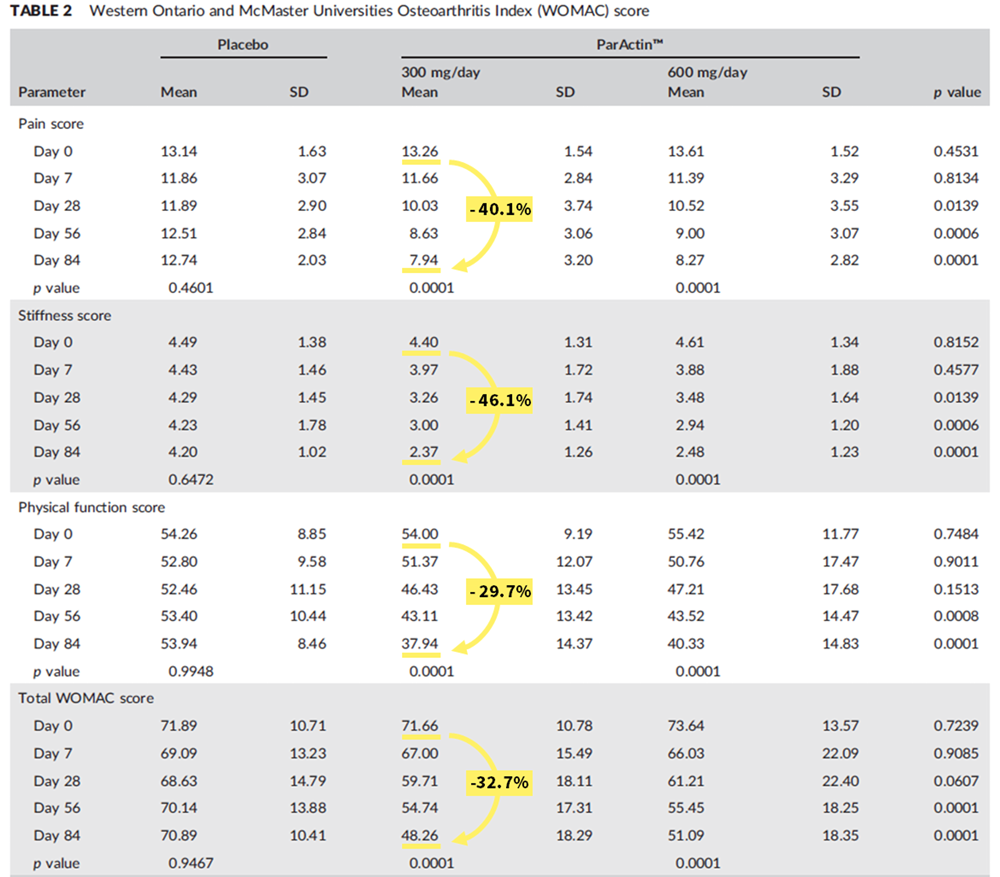
"In the clinical trial, participants felt improvement from the first week of taking ParActin, and after 3 months, pain, stiffness, and physical function improved by 32.7% in total score."
Reference: Juan L Hancke, Shalini Srivastav, Dante D Cáceres, Rafael A Burgos. A double-blind, randomized, placebo-controlled study to assess the efficacy of Andrographis paniculata standardized extract (ParActin®) on pain reduction in subjects with knee osteoarthritis. Phytotherapy Research.
3. Is caring for joints enough? Weakening bones and cartilage need care, too
Don't assume that reducing inflammation is all it takes. Joint health calls for comprehensive care that covers not only the joints but also bone and cartilage health. For example, even if your joints are healthy, hollow bones can turn a small fall into a serious injury such as a fracture. For this reason, middle-aged and older adults are also advised to take vitamin D, which is hard to get from food alone, in the easily absorbed form of cholecalciferol (vitamin D3). Vitamin D3 is known to help calcium absorption to build bone and to lower the risk of osteoporosis.
Glucosamine, the first thing many people think of for cartilage health, is also a leading functional ingredient. When choosing a glucosamine product, it is best to choose one with high bioavailability. Among them, N-acetylglucosamine is known to have a low fecal excretion rate of 21% compared with regular glucosamine, and a loss rate in the body that is also comparatively 54% lower. This means its bioavailability is about 3 times higher than that of regular glucosamine.
Taking vitamin D3 and N-acetylglucosamine together with ParActin is therefore expected to make joint health care more effective.
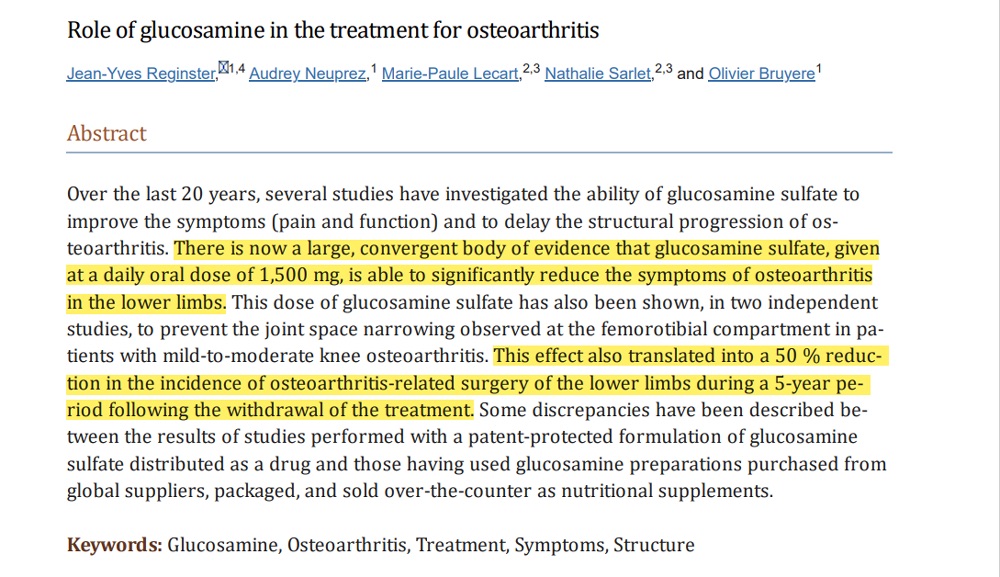
"There is much evidence that daily oral administration of 1,500 mg of glucosamine sulfate can significantly reduce osteoarthritis symptoms. (omitted) It is also interpreted as a 50% reduction in the incidence of osteoarthritis-related surgery during the 5 years after treatment ended."
Reference: Jean-Yves Reginster,corresponding author, Audrey Neuprez, Marie-Paule Lecart, Nathalie Sarlet, Olivier Bruyere, Rheumatology International, Role of glucosamine in the treatment for osteoarthritis.
Rather than relying only on medical treatment or specific ingredients, preventing joint disease with light everyday exercise is also a good approach. For knee arthritis, walking slowly on flat ground, swimming, or riding a stationary bike to strengthen the surrounding muscles and ligaments helps ease pain. However, if a joint becomes very painful or swollen during exercise, it is best to stop right away and apply ice. Keeping a healthy weight through exercise also helps keep arthritis from getting worse. It is best to avoid activities that can worsen symptoms, such as hiking, climbing up and down stairs, and squatting. We hope steady care keeps your joints healthy.
This magazine provides health information about ingredients, not about the efficacy or effects of any specific product.